The cannabis industry is reaching a critical turning point. For years, the “potency paradox” led consumers to believe that the highest THC percentage was the sole indicator of quality. In an era where 30% THC flower has become common, many enthusiasts are discovering a frustrating reality: high numbers don’t always lead to high satisfaction.
As the markets in Arizona, Maryland, and Ohio mature, we are seeing a shift toward a more sophisticated metric: the terpene profile. New clinical data from Johns Hopkins University and the University of Arizona reveals that terpenes, the aromatic compounds found in the plant’s resin glands, are actually the “steering wheel” of your high. They dictate whether you feel energized, relaxed, or anxious.
By moving beyond the outdated “Indica vs. Sativa” binary and focusing on the Entourage Effect, Story Cannabis brands like Fade Co. are proving that a lower-THC flower with a rich, complex terpene profile often delivers a more potent, balanced, and memorable experience than a high-potency “THC bomb.”
Table of Contents
The Cannabis Potency Paradox: Why 30% THC Isn't Always "Better"
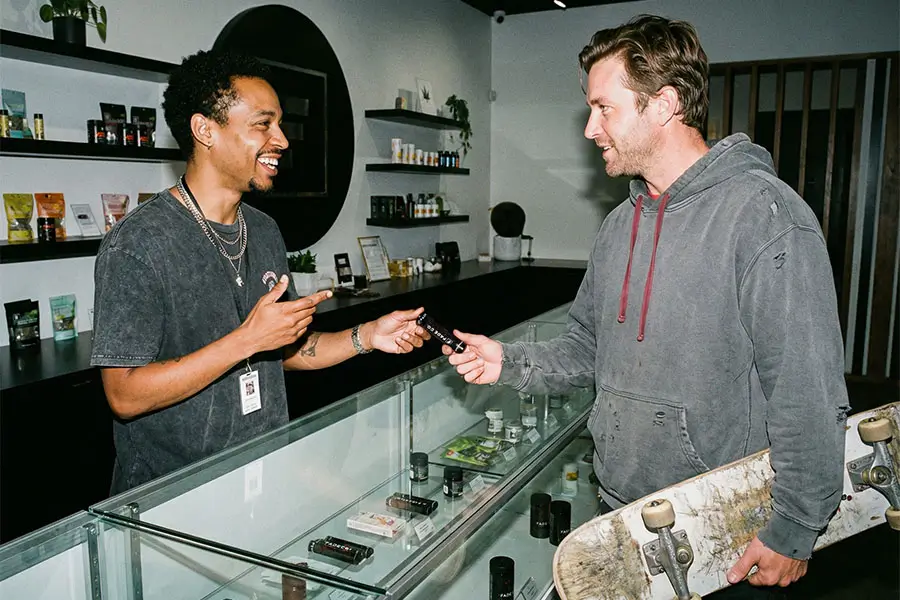
We’ve all been there: you walk into a dispensary and ask for the highest-testing flower on the shelf. While these strains are botanical marvels, they often produce what consumers describe as a “hollow” high, a rush of intensity that lacks depth, flavor, and duration.
The reality? THC is just the engine; terpenes are the driver.
Consider the difference between a 90% THC distillate vape and a 75% THC Fade Co. Live Resin cartridge. The distillate often feels and tastes “flat” because the extraction process strips away the secondary metabolites. Live Resin, however, preserves the natural terpenes that trigger the Entourage Effect, a physiological synergy where cannabinoids and terpenes work together to produce a comprehensive effect on the body and mind.
The Death of “Indica vs. Sativa”
For decades, the industry relied on the “Sativa for energy, Indica for sleep” shorthand. However, modern research suggests these terms describe the plant’s physical shape, not its chemical effect.
- Energy and Focus are the result of high concentrations of Limonene, Pinene, or Terpinolene.
- Sedation and Relaxation are driven by Myrcene and Linalool.
By focusing on terpenes, you can accurately predict how a strain will make you feel, regardless of whether the label says Indica or Sativa.
The "Super Class" of Terpenes: A Deep Dive
To find your perfect vibe at Story Cannabis, you need to look past the THC score and identify the dominant terpenes in the mix.
Terpene | Aroma | The Feeling | Found In |
Myrcene | Earthy, Musk, Clove | The “Couch-Lock” king; deep sedation and muscle relaxation. | |
Limonene | Citrus, Lemon, Orange | Euphoric, mood-boosting, and clinically shown to help reduce anxiety. | |
Caryophyllene | Black Pepper, Spice | Supports physical relief and anti-inflammatory effects without the “heavy” head high. | |
Linalool | Lavender, Floral | Calming, supports relaxation and deep sleep. | |
Pinene | Pine, Rosemary | Alertness, memory retention, and a “cerebral” lift. | |
Terpinolene | Floral, Pine, Apple | Complex, “trippy” energy; often found in Haze varieties. | Jack Herer lineages |
Humulene | Hoppy, Woody | Anti-inflammatory and unique for its appetite-suppressing potential. | GSC derivatives |
The Science of Scent and Terpenes: Why the "Nose Knows"
It isn’t just marketing; it’s biochemistry. Your olfactory system is directly wired to the limbic system, the part of the brain responsible for emotion and memory.
1. The Anxiety Mitigator (Johns Hopkins, 2024)
A pivotal double-blind study by Johns Hopkins researchers found that the terpene d-Limonene significantly reduced the anxiety and paranoia frequently associated with high-dose THC. This suggests that for users prone to the “jitters,” a 20% THC strain high in Limonene is safer and more effective than a 15% THC strain without it.
2. The Pain Relief Synergy (University of Arizona)
Research from the University of Arizona Health Sciences demonstrated that terpenes like Geraniol and Linalool produce pain-relieving effects independently by activating the body’s CB1 receptors. When combined with THC, the pain reduction was amplified without increasing the negative side effects. This proves that full-spectrum products like flower and live resin offer a superior “therapeutic index.”
Vaporization & Temperature: Unlocking the Profile
For consumers using dry herb vaporizers or adjustable vape pens, temperature plays a major role in terpene expression and overall effects. If heat is too high, delicate terpenes can degrade; too low, and vaporization is inefficient, limiting flavor and effect.
- Low (310–330°F): Emphasizes flavor-forward, lighter terpenes (e.g., pinene, limonene traces). Clearer, less sedating effects.
- Mid (330–370°F): Broad terpene expression + efficient THC vaporization. Often perceived as the “entourage sweet spot.”
- High (370–390°F): Fewer terpenes overall, more cannabinoids and degradation products. Heavier body effects, harsher vapor.

How to Shop Your Local Menu by Terpene
The regulatory landscape is changing to favor the consumer. Here is how to navigate the menus in Story’s key markets:
Maryland (Hyattsville, Silver Spring, Waldorf)
Maryland’s regulations (COMAR 14.17.18) are among the most transparent in the nation. State law requires testing and full disclosure of the terpene profile on the product label.
The Move: Look for “Total Terpenes” on the back of the jar. If the total is over 2.0%, you’re holding premium flower. If it’s over 3.0%, it is a master-tier batch with “boutique” appeal.
Arizona (Phoenix, Chandler, Glendale, Tolleson)
In Arizona, terpenes aren’t always printed on the front of the packaging, but they are always in the COA (Certificate of Analysis).
The Move: Scan the QR code on your Fade Co. or Just Flower bag. Look for the “Top 3” terpenes. If you see Myrcene and Linalool at the top, prepare for a relaxing evening.
Ohio (Cincinnati, Cleveland, Columbus)
As Ohio transitions into the adult-use market, the state’s labeling rules mandate that terpenoid profiles be available to consumers.
The Move: Match your terpene to your goal. If you are a medical patient looking for inflammation relief, ask your Story budtender for a Caryophyllene-dominant strain.
3 Tips for a Better Experience
- Trust Your Nose: At deli-style shops, always smell the flower. If the scent is inviting and “bright,” your body is signaling a compatibility with that terpene profile. If it smells “off” or “too sharp,” it may induce a negative reaction.
- Check the Harvest Date: Terpenes are volatile hydrocarbons; they evaporate over time. Flower harvested within the last 3–4 months will always be “louder” and more effective than old, dry buds, regardless of the THC score.
- Live Resin Over Distillate: If you’re buying vapes, choose Fade Co. Live Resin. It is produced from fresh-frozen plant material, preserving the delicate monoterpenes that are lost in the high-heat processing of pure distillate.
Frequently Asked Questions
Can terpenes really change my high?
Absolutely. Think of THC as the volume knob on a radio, but terpenes are the actual music playing. You can turn the volume to 100 (high THC), but if the music is bad (low terpenes), it’s just loud noise.
What is the best terpene for anxiety?
Limonene and Linalool are the gold standard. They help modulate the “fight or flight” response in the brain, allowing for a relaxed, euphoric experience without the racing heart.
Why is Fade Co. considered "premium" if the THC is the same as value brands?
Fade Co. focuses on “boutique appeal” and “loud” profiles. We prioritize a meticulous cure and terpene preservation, ensuring the aromatic intensity is high. That “loud” smell is the physical evidence of craft quality.
How do I store my cannabis to keep the terpenes fresh?
Keep your flower in an airtight glass jar in a cool, dark place. Heat, light, and air are the three enemies of terpenes. Avoid plastic bags, which can “leach” the aromatics out of the flower.
Next Steps
Ready to stop chasing percentages and start chasing profiles? The “Story” is in the terpenes. Visit any Story Cannabis location today in Arizona, Maryland, or Ohio. Our budtenders are trained to help you read your COAs and find the specific aromatic profile that fits your lifestyle.