If you’ve ever tried a homemade edible that hit way too hard (or didn’t hit at all), you already know why learning how to make cannabutter the right way matters. Cannabutter is the classic starting point for homemade edibles because it’s versatile, beginner-friendly, and easy to portion once you know your numbers.
In this guide, we’ll walk through a simple stovetop method, step by step, plus dosing math that helps you get consistent mg per serving (no mystery brownies). We’ll also cover how to use shake or trim without ending up with bitter, grassy butter, and a slow cooker option if you’d rather “set it and forget it.”
Table of Contents
Making Cannabutter at a Glance
Cannabutter is simple: decarb your cannabis at low heat, gently simmer it in butter for about an hour, then strain and chill. Once it sets, you can use it in any recipe that calls for butter. Test a tiny amount first so you know how strong your batch is. Swap out butter for coconut oil, olive oil, or another food-friendly fat.
Quick note: Effects vary by person. Start low, go slow, and always keep infused foods clearly labeled and out of reach of kids and pets.
How Long Does It Take to Make Cannabutter?
Many of our dispensary shoppers ask this because they’re deciding whether cannabutter is a weeknight project or a weekend project, and whether they need to babysit the stove the whole time. The good news: you can make cannabutter in an afternoon, and a lot of that time is hands-off.
Here’s a realistic timeline for a first batch:
- Prep: 5–10 minutes (break up cannabis, gather tools, set up a strainer)
- Decarb: ~25–40 minutes (activates THC so your cannabutter actually works)
- Infusion (stovetop): ~45–60 minutes (low and controlled—this is where flavor and potency get decided)
- Strain + cool: 10–20 minutes
- Set in the fridge: 1–2 hours (or overnight if you’re not in a rush)
Hands-on time vs. hands-off time: You’re really only “actively doing things” for about 20–30 minutes total. The rest is monitoring temperature, stirring occasionally, and letting it chill.
Want to make it faster?
If you’re searching how to make cannabutter fast, the best shortcut is making the process efficient, not aggressive:
- Keep your cannabis coarsely broken up (not powder)
- Use controlled heat (avoid boiling or frying your butter)
- Don’t assume “longer infusion = stronger butter.” Past a certain point, you’re often just extracting more green, bitter flavors.
Bottom line: cannabutter doesn’t have to take all day, but the “fast” version still respects the two non-negotiables: decarb and gentle infusion.
Dosing Your Cannabutter: Math Made Simple
You don’t need complicated math to get a good sense of how strong your cannabutter will be. Just start with the cannabis you have.
Example:
Let’s say you’re using 3.5 grams of cannabis (an eighth) at 20% THC.
That eighth contains roughly 700 mg of total THC before infusion (3500 mg x 0.20 potency = 700 mg total THC). If you infuse it into 1 pound of butter (2 cups), your finished cannabutter will be moderate in strength—easy to portion and beginner-friendly once you test a small amount.
Here’s the part most people overthink:
- Want stronger butter? Use more cannabis or less butter.
- Want milder butter? Use less cannabis or more butter.
You’re just spreading the same total THC across more or less butter.
Keep in mind that typically about 80% of the total THC ends up in the butter, so subtract another 20% to calculate the final potency.
Then, when baking, simply divide the total THC from the amount of butter used by the number of servings in the recipe for a THC/serving breakdown.
Before using your finished butter in a recipe, test a single dose and wait 2 hours. Once you know how that small amount feels, you can confidently use it in baking or cooking.
Decarboxylate Your Cannabis (Do This First)
Before you do anything with butter, you need to activate your cannabis.
Raw flower (or shake) is rich in THCA, which doesn’t produce the classic edible effects until it’s converted into THC with gentle heat. That conversion is called decarboxylation.
If you skip decarboxylation, you’ll mostly end up with butter that tastes like cannabis plant material but delivers very little of the classic edible effect. You’ve extracted flavor and chlorophyll, not activated THC.
It’s all about a sweet spot of temperature and duration. According to a decarboxylation kinetics study published in Cannabis and Cannabinoid Research, THCA (the non-psychoactive acid form of THC) converts efficiently to THC when heated to 230°F for 30 minutes.
What You’ll Need To Decarb
Tools
- Baking sheet
- Parchment paper or aluminum foil
- Oven thermometer (strongly recommended—most ovens run hot or cold)
- Small spatula or spoon for stirring
Cannabis
- Cannabis plant material*
- Flower: break up by hand
- Shake: usually ready as-is
*You can decarb however much you’d like for potency. See Dosing Your Cannabutter section for guidance. You’ll use this decarbed cannabis for any method: stovetop, slow cooker, or small-batch.
Step-by-Step Decarb Instructions
1. Preheat the oven to 230°F (110°C).
If you have an oven thermometer, use it to double-check. A lot of home ovens are off by 10–25 degrees.
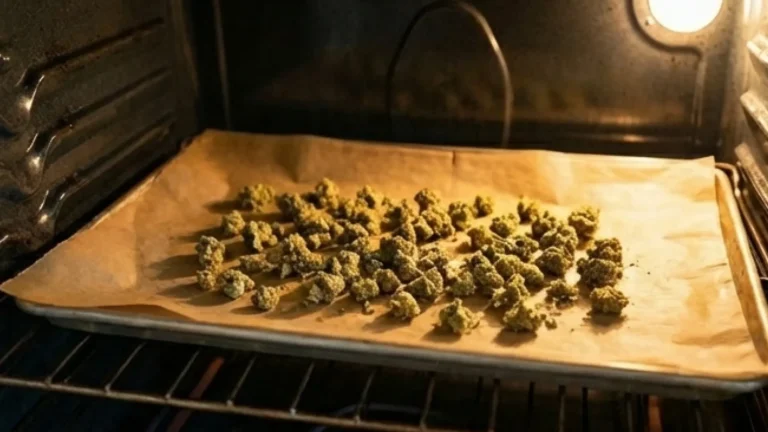
2. Prepare the cannabis. Break flower up into small, even pieces with your fingers or scissors. Think “small popcorn” or “tiny broccoli florets.” For shake and trim, pick out any obvious stems; no extra grinding needed.
3. Line the baking sheet with parchment or foil.
Spread the cannabis in a thin, even layer. Clumps = uneven decarb. You want everything to see the heat.
4. Bake for 30–40 minutes, stirring gently every 10 minutes.
You’re aiming for:
- Color: light golden-brown, not dark brown or black
- Texture: dry and slightly crumbly, not moist
5. Cool completely.
Then, if needed, lightly grind to a medium-coarse texture, more like drip coffee, not espresso. Powdery cannabis pulls more harsh, bitter flavors into your butter.
Once it’s decarbed and cooled, your cannabis is “activated” and ready to infuse.
4 Common Decarb Mistakes
Decarboxylation is simple, but it’s not foolproof. Most “my edibles didn’t work” stories trace back to one of a few common decarb mistakes:
- Skipping decarb entirely. This is the #1 reason homemade edibles don’t work.
- Too much heat. Cranking the oven to “get it done faster” risks degrading cannabinoids and burning off terpenes. Stay in the low, slow range.
- Grinding to dust before decarb. Fine grind = more surface area = more chlorophyll and harsh flavors extracted later. Keep it coarse.
- Uneven layers. Thick piles cook unevenly. A single, thin layer gives you more consistent results.
With decarb done, you’ve handled the most important step. Next, we’ll move into how to make cannabutter stovetop (step-by-step) using this activated cannabis.
How to Make Cannabutter on the Stovetop (Step-by-Step)
The stovetop method is the classic for a reason: it’s beginner-friendly, easy to control, and doesn’t require any special equipment besides a pot and a thermometer. As long as you keep your heat gentle and steady, you’ll get a reliable infusion every time.
What You’ll Need for Infusion
Tools
- Small saucepan or a simple double-boiler setup
- Thermometer (candy or digital) — seriously helpful for temperature control
- Wooden spoon or heat-safe spatula
- Fine mesh strainer (cheesecloth optional)
- Heat-safe container with a lid
Ingredients
- Decarboxylated cannabis (however much you prepped earlier)
- Unsalted butter (1 cup is standard for a first batch)
- ¼ cup water (optional): helps prevent scorching and separates cleanly during cooling
Tip from our shoppers: If you’re planning to use cannabis with a very pronounced aroma (or you’re working with trim), the water method tends to yield a smoother-tasting finished butter.
Instructions
Step 1: Melt the Butter (Gently)
Add 1 cup unsalted butter and 1/4 cup water to your saucepan. Melt it over low heat until fully liquid. You’re not trying to simmer yet, just making sure everything melts evenly.
If you prefer not to use water, that’s fine. You’ll just want to watch the temperature more closely to avoid scorching.
Step 2: Add the Decarbed Cannabis
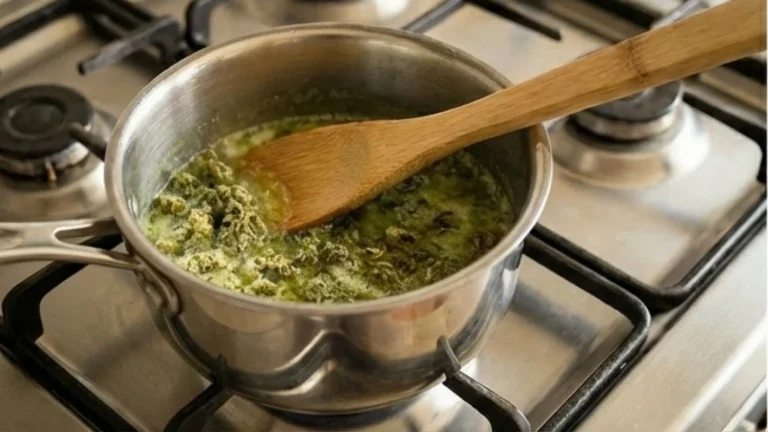
Once the butter is melted, stir in your decarboxylated cannabis. Make sure it’s fully submerged so all the cannabinoids have direct contact with fat.
Keep your burner at low or low-medium heat, aiming for:
- 160°F–190°F (71°C–88°C)
- Never let the mixture boil, bubbling means you’re too hot.
This range preserves cannabinoids while letting them slowly infuse into the butter. Too much heat = lost potency and harsher flavor.
Step 3: Infuse for 45–60 Minutes
This is where method matters. Many older guides tell you to simmer for 2–4 hours, but long infusions often extract more plant flavor than potency.
A 45–60 minute infusion window hits the sweet spot: strong extraction, less bitterness.
During infusion:
- Stir every 10–15 minutes
- Keep the cannabis submerged
- Check temperature occasionally
If it creeps above 190°F, lower the heat or pull the pot off the burner for a moment.
Step 4: Strain Carefully (Don’t Squeeze)
When the infusion time is up, pour the mixture through a fine mesh strainer into your heat-safe container. Cheesecloth works too, but it absorbs precious butter, and squeezing it forces chlorophyll and fine sediment into your final product.
Let gravity do the work. A slow, patient strain makes noticeably cleaner-tasting cannabutter.
If you used water, your butter will naturally separate as it chills: butter on top, water underneath.
Step 5: Cool and Set
Refrigerate your container for 1–2 hours (or overnight). Once fully solid:
- Lift off the firm butter layer
- Discard the water underneath (if used)
- Pat the bottom of the butter disc dry
- Store in an airtight container
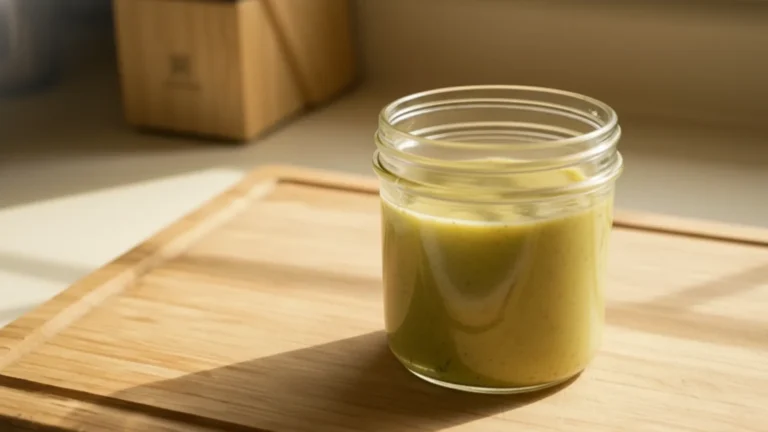
Properly infused cannabutter should have a pale to mid-green tint. Bright green or very herbal flavor usually means too much plant matter got through (we’ll fix this in troubleshooting if it happens).
Using Your Stovetop Cannabutter
You can use cannabutter in almost any recipe that calls for butter—brownies, cookies, banana bread, chocolate sauces, pasta finishes, garlic toast, and more.
Two quick guidelines:
- Avoid high heat (frying, searing) which can degrade THC.
- Substitute slowly: You don’t need to replace all butter in a recipe. Many beginners use half cannabutter, half regular butter to keep dosing manageable.
Next, we’ll walk through consistent dosing math so you know exactly what you’re working with and never end up with accidental “mystery brownies.”
Making Cannabutter With Shake & Trim (To Avoid a Bitter Taste)
Using shake or trim is a budget-friendly way to make cannabutter, and it works just as well as flower—as long as you manage flavor. Shake usually tastes cleaner; trim can carry more chlorophyll, which is why some batches turn out “grassy.”
Here’s how to get good results with both.
Use the Same Infusion Method, With Two Adjustments
- Don’t grind shake or trim.
Both already have small particle size. Grinding creates powder, which extracts more bitterness. - Strain through a fine mesh (no squeezing).
Chlorophyll and fine sediment are the main sources of harsh flavor. Give it time to drip.
Keep the Infusion on the Shorter Side
A 45–60 minute infusion window helps avoid over-extracting plant flavors, especially with trim. Longer simmers don’t mean stronger butter—they often just mean greener butter.
Optional: “Butter Wash” for Milder Flavor
If your cannabutter tastes too herbal, melt it with a bit of warm water, chill, lift off the solid butter, and repeat once. This removes some chlorophyll without affecting potency.
Bottom line: Shake makes excellent cannabutter. Trim works too—you just need gentler handling and a lighter touch with heat.
How to Make Slow Cooker Cannabutter (Crock Pot Method)
If you prefer “set it and forget it,” the slow cooker version of how to make cannabutter in a slow cooker or how to make cannabutter in a crock pot is your best friend. It keeps the temperature steady and requires minimal stirring.
How to Do It
- Add butter, decarbed cannabis, and a splash of water to your slow cooker.
- Set to LOW. Most slow cookers run around 160–190°F, right in the infusion sweet spot.
- Cook for 2–3 hours, stirring once or twice.
- Strain gently and refrigerate until the butter separates and sets.
Pros
- Extremely beginner-friendly
- Less odor and less monitoring
- Harder to scorch the butter
Cons
- Slightly longer infusion time
- Some slow cookers run hot, avoid the HIGH setting
This method is ideal for anyone who prefers consistency over stovetop babysitting.
Small-Batch Cannabutter (Using Just 2–3 Grams)
You don’t need a full ounce, or even an eighth, to make infused butter. If you’ve only got a couple grams left, you can still make a perfectly usable batch.
Example: How to Make Cannabutter With 2 Grams
If your cannabis is around 20% THC, then:
- 2 grams contains roughly 320 mg THC total
- Infuse it into ½ cup of butter for a moderate-strength cannabutter
- Infuse into 1 cup for something milder and easier to portion
Why Make a Small Batch?
- Great for first-timers testing potency
- Easy to blend into a single recipe without leftovers
- Lets you try different strains without committing to a full pound of butter
Just follow the same decarb and stovetop steps, only the butter volume changes.
Start Infusing Cannabutter Like a Pro with Story Cannabis
Cannabutter doesn’t have to be complicated. Once you understand decarboxylation, gentle heat, and basic dosing, you can make infused butter that’s consistent, predictable, and easy to use in any recipe.
Keep your heat low, avoid over-grinding, and strain patiently for the best flavor. If you’re using shake or trim, shorter infusions and fine filtering make a big difference. And remember: potency is flexible, you can always adjust by changing how much butter or cannabis you use.
When you’re ready to make a batch, stop by your local Story Cannabis in Maryland, Arizona, or Ohio. Our budtenders can help you choose the right flower or shake for edibles and walk you through THC percentages so you can dose your butter confidently.
Making Cannabutter FAQs
Do you really need water in the butter infusion?
You don’t have to use water, but it helps prevent scorching and makes straining easier—your butter solidifies on top, water sinks below. If you prefer pure butter, skip the water and just keep your heat low. Both methods work; water simply gives beginners a wider margin of error.
Can I mix cannabutter with regular butter?
Absolutely. Blending infused butter with regular butter is the easiest way to adjust potency for different recipes. If your cannabutter ends up stronger than expected, dilute it until each tablespoon feels manageable. Many home cooks use a 50/50 blend for everyday recipes.
Can I use cannabutter in any recipe?
Mostly, yes. Just avoid high-heat frying, which degrades THC. For baking, you can replace some or all of the regular butter with cannabutter. If you want a lower potency, mix cannabutter with plain butter until you reach a comfortable strength.
How long does homemade cannabutter last?
Stored in an airtight container, cannabutter keeps 2–3 months in the fridge and 6+ months in the freezer. Light and air slowly degrade cannabinoids, so keep it sealed and use opaque containers when possible. If it smells sour or develops mold, discard and make a fresh batch.
Can I use cannabutter for sautéing or frying?
Infused butter loses potency at high heat. It’s fine for gentle stovetop cooking—like finishing veggies, pasta, or toast—but avoid pan-frying or searing. If you want infused foods at higher temperatures, add cannabutter after cooking instead of using it as the primary cooking fat.
Can I use coconut oil or ghee instead of butter?
Absolutely. Cannabis infuses into any high-fat, food-safe cooking fat, including ghee, coconut oil, avocado oil, and even olive oil. The process is the same: decarb, gently heat the fat, infuse, strain, and chill.
Potency and dosing math stay the same across all fats. Just follow the same low-heat infusion method and skip the optional water step when you’re not using butter.